The Real Power of AI Isn't in the Chat Window
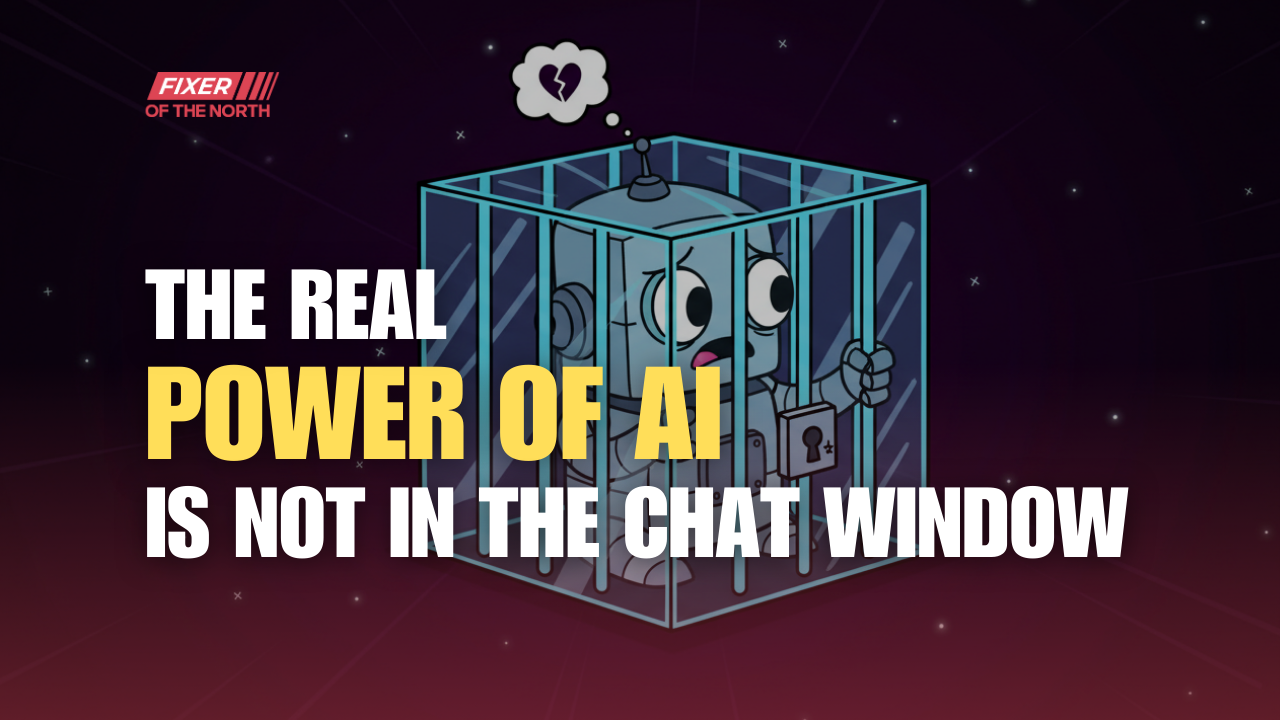
AI chatbots are impressive. But they're also (in their simplest state) trapped in the box they live in. You can ask ChatGPT or Claude anything. You can brainstorm, write, analyze. But when you close that window, nothing really happened. The AI didn't do anything, it just talked. The real gains from AI don't come from conversations. They come from orchestration - connecting AI to other systems, with actual constraints, running actual processes. That's where things get interesting.
I've been building with Claude Code for a while now. For those unfamiliar, it's Anthropic's command-line coding agent - you give it tasks, it writes code, runs commands, creates files. It's remarkably capable. But the more I use it, the more I feel left wanting more. Take GitHub access for example. Claude Code wants to use GitHub's own CLI, which by default authenticates you to everything. Every repository in your org. Every integration. Full permissions. And that makes sense - the CLI is built for you doing stuff in your own account after all. But Claude is not you. No matter how amazing it is, it still makes occasional mistakes, and giving it full access to everything seemed like a bad idea. I didn't feel like creating custom privileges or separate users just for Claude Code either.
And there was another issue. While Claude Code is busy building things, so much stuff flies through it that small instructions easily get lost. The larger the codebase and the feature it's working on, the more it has to keep in context - and the less likely it is to remember details that aren't immediately relevant to the work at hand. So if I have a certain way I want PRs to be written, I can instruct it, but it's hit or miss whether it will remember.
The subagent idea
I started thinking about subagents as a solution to this. Claude Code already uses them, but they run locally - so they have the same auth problem. I wanted isolated subagents that I would fully control, including the exact tools they have access to, and with what parameters. What if Claude Code could delegate tasks to specialized agents - agents that run remotely, with their own instructions, their own tools, and their own guardrails?
For example: I wanted Claude Code to be able to create pull requests. But I also wanted a sanity check. If the PR title is vague or the description is empty, the request should just fail. Not a warning - a hard stop. Because Claude Code, knee-deep in a coding session, will regularly forget instruction details. A separate agent with one job - "make sure PRs are properly documented" - won't forget.
This separation of concerns matters. The coding agent focuses on code. The PR agent focuses on PR quality. Neither needs to know what the other is working on, they just focus on their own responsibilities. And once you have that pattern in place, you can extend it anywhere. An agent that can post to #engineering Slack channel but can't DM anyone. A GitHub issue agent that only creates and update issues in select repositories. A database agent with read-only access to analytics tables.
Each agent is a controlled unit of capability. Safe for AI or even unwitting humans to invoke, simple for you to control.
Building MoiAgent
So I decided to build it myself. The first version took about six days - three days of actual building with Claude Code and Opus 4.5, three days of polishing. The core idea is simple: CLI tools that run remote AI agents with customizable tools. You can run them from your terminal, from Claude Code, or even from a cron job. The request hits a remote agent that executes it against the instructions it has, with whatever tool access you've configured.
The key is that configuration happens centrally. You define what each agent can do from a dashboard. Those rules are enforced remotely - no local overrides, no "but I really need this" exceptions. When you update the config, it syncs everywhere instantly.
Once MoiAgent was working, solving problems with new agents became trivial. I created an assistant for one of my npm modules that handles merging PRs, checks that tests pass, and notifies a dedicated Slack channel about new releases. All of its tools are scoped to that single repository and select Slack channels, but it can do many things within that scope. Setting it up took minutes - I just defined the tools and guardrails, and it was live.
This is different from something like Zapier, which does automation well but in a rigid, predefined way. MoiAgent agents are AI-native. They interpret requests, make decisions, and can handle ambiguity. But they still operate within strict guardrails you define.
Why orchestration matters
The real insight here isn't really about MoiAgent. It's about where AI-derived value lives. Asking questions in a chat window is useful. But it's still mostly you doing work, with AI as a sounding board. Orchestration creates value out of the busy-work. You define the process - "when X happens, do Y with constraints Z" - and then it just runs. Repeatedly. Reliably. Without you in the loop.
And because each piece has explicit boundaries, even total failure is contained. A misconfigured Slack agent might post wrong information. It can't delete your repository. The blast radius is controlled by design. This is how AI becomes infrastructure instead of just a tool. Infrastructure you can trust because you built the guardrails yourself.
Try it
moiagent.com is live. There's a demo on the front page showing how it works.
If you want to give AI agents real capabilities without giving them the keys to everything — or you're looking for a lightweight way to build workflows that actually run reliably — this is what I built it for.