First-Class AI Agents Are the Requirement in 2026

You're working in an app, chatting with the an AI assistant. It tells you to add a task and reorder your priority queue based on some dependencies. Smart suggestion and makes total sense. So you do it. You ask the agent for the task title and description. You get another great response and copy that into the task form. Add it to your priority list manually. Drag things around based on what depends on what.
The agent already knew all of this. It just told you what to do. And now you're the middleman between the AI and the interface. Do this enough times and you start wondering why you're here at all. You're the middleware. The primus motor of the AI agent - The agent had the all the answers, you had the capability to act on them. The only barrier between wanting something done and having it done was a bunch of forms you had to click through yourself.
This is the case for first-class agents. The agent should be able to do what you can do. Not describe things for you to execute manually. Not generate text for you to paste somewhere else. Actually do the work. When an AI suggests something useful, the obvious next thought is "okay, do it." If the response is "I can't, but here's how you can," you've already failed the user.
What First-Class Means in Practice
A first-class agent has access to every feature your application offers. Not through the UI, but through your APIs. If a user can do it by clicking around, the agent can do it via API on their behalf. The coverage ends up being roughly the same.
You equip the agent with all the functionality your app already exposes. Same APIs. Same functionality.
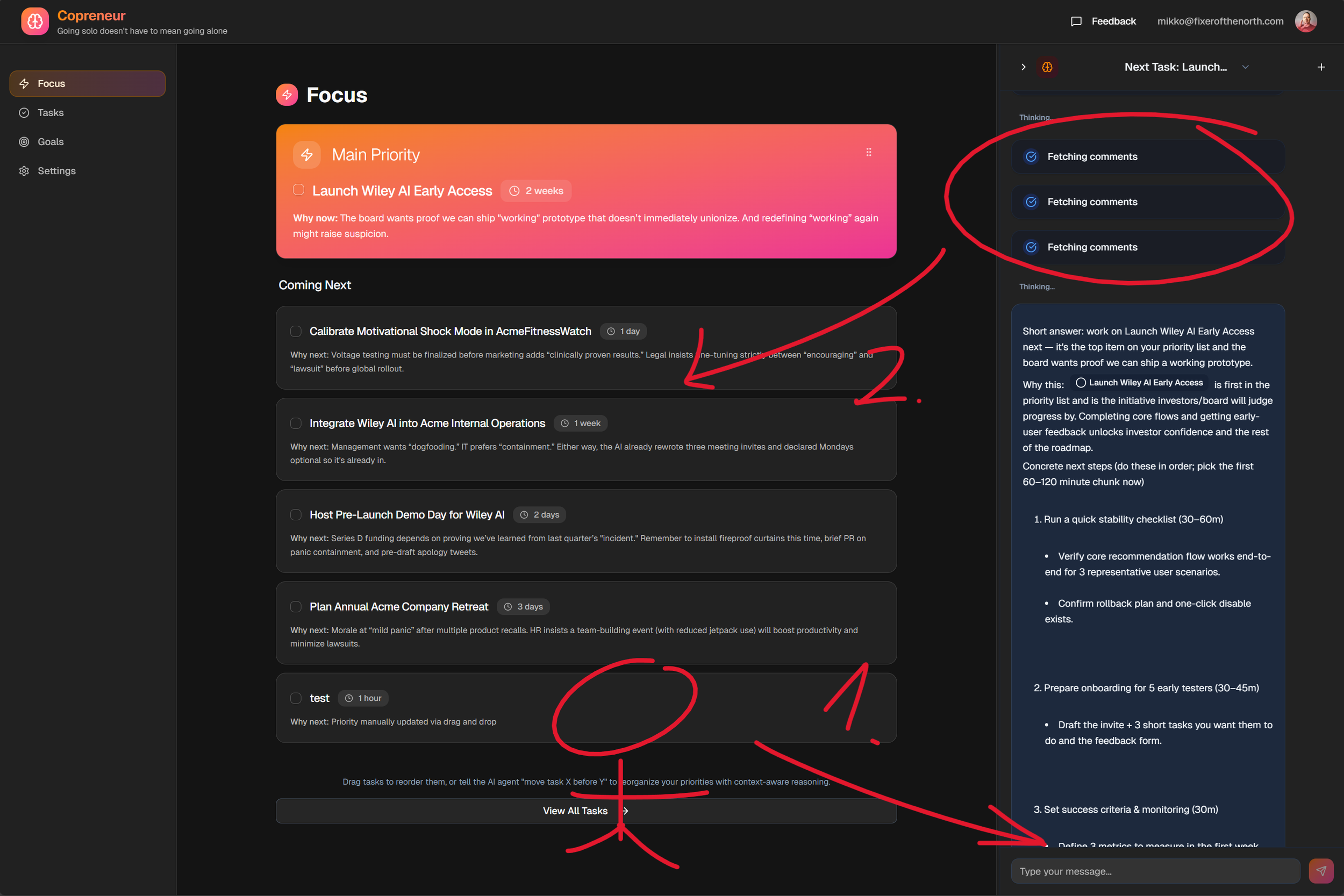
Here’s a simple example of the Copreneur.ai first-class agent in action. The user asked about specific priorities, and the agent is gathering information before responding. The action itself is straightforward, but the key is that the agent chose—based on the user’s request—to dig around using the same functionality the user has, ensuring it had the latest details on those tasks.
Making It Safe
Full privileges for AI agents should sound dangerous. The failure modes are obvious: the agent deletes something you needed, or sends an embarrassing message to someone important. "The agent can do anything" becomes a fast way to destroy trust.
The fix is to constrain what the agent can touch in the first place. Rather than giving it broad database access and hoping for the best, you scope each tool tightly. Each one only touches the specific context it needs. The agent can't delete resources it was never given access to. It can't send messages through channels that aren't wired up.
And critically: the agent never gets more access than you do. You can't ask it to check on your friend's account or peek at data you're not authorized to see. At maximum, the agent inherits your privileges. Usually it should have fewer.
For example, in Copreneur.ai, the workspace IDs is always baked into the agent’s tool context so it doesn't even have option to reach outside its sandbox. The danger is trusting the agent to supply its own scope—“you may only touch workspace abc123.” That’s hackable and will break.
Where Are We Headed
Users will start to expect this. Not as a premium feature but as baseline functionality.
Consider how fast "search" went from impressive to mandatory. Or mobile-responsive design. Or even simple things like dark mode. Features that seemed like nice extras became requirements within a year or two.
Agents that can actually act inside your application are on that same path. Apps that have them will feel current. Apps that don't will quickly feel broken. "Why can't I just ask it to do this?" will be a common complaint. "Because we haven't built that yet" will stop being a good enough answer.
Building For First-Class Agents
If you're launching a service today, design for agent consumption from day one. Every feature a user can trigger should also be callable by an agent, and every agent action should surface to the user.
Already running a service? Pinpoint the high-value, high-friction tasks your users repeat—those are the first to hand to agents. Build the tooling that lets an agent execute them with explicit user permission.
In Copreneur.ai, for instance, the agent can assign tasks, reprioritize on the fly, or set your schedule: “Set my workday 9–5, but end an hour early on Thursday.” Skip the clicks if you like; ask the agent and watch the UI update in real time.
Apps that nail this feel effortless. The rest feel like they’re inventing busywork for no apparent reason.