Your Product Is a Weekend Project Now

Three months ago, building a custom CRM would have taken a team of developers six months and cost you mid-six figures. Today, one person with Claude Code can spin up something functionally equivalent in a weekend. Not a toy. Not a prototype. Working software.
If you're running a company that sells software and nothing else, you should be paying attention.
The shift happened in weeks
We've been talking about AI eating software for years. But in the last months of 2025 we actually crossed a threshold. Claude Code armed with Opus 4.5 reached a point where "vibe coding" stopped being a task-scale tool and started being a viable way to build full production software.
The economics of producing software are about to collapse.
For decades, companies have been forced into a specific pattern: find software that does roughly what you need, pay for it monthly, then contort your processes to fit its limitations. You wanted a CRM that matched how your sales team actually works? Too bad. Learn to work like Salesforce expects you to, or spend millions on customization. That constraint is effectively gone now.
What dies first
The companies most exposed are the ones selling expensive software with no additional value wrapped around it. Pure SaaS. Code as the product, nothing else.
Think about something like HubSpot. Thousands of dollars per month for what is, at its core, a database with forms and email automation. When spinning a clone takes a few hours, when adapting it to your exact processes becomes trivial, when the hosting costs are a rounding error compared to the subscription, what exactly are you paying for?
The answer used to be: you're paying because building it yourself was impossible. That answer doesn't work anymore.
Not every SaaS company dies. The ones that survive will be the ones that figured out they were never really selling software. They were selling expertise, or trust, or platforms, or integration with existing ecosystems, or compliance guarantees. The software was just the delivery mechanism. But the ones that thought the code itself was the moat are standing squarely on train tracks.
This still won't happen overnight
To be clear: most companies aren't going to wake up tomorrow and start building their own tools. The capability exists, but capability and adoption are different things.
Some companies are focused on their core business and have no interest in becoming software shops, even if the software is easier to build now. Others don't have developers on staff who could take this on, and hiring for it feels like a distraction. Many will look at their current vendor relationships and decide the switching costs aren't worth it, at least not yet.
So the change will be gradual. A few early adopters build custom solutions and realize how much better their operations run. Their competitors notice. Slowly, the expectation shifts. What seemed like overkill becomes standard practice.
But gradual doesn't mean optional. The economics have fundamentally changed. Once building custom software becomes cheap enough, the question stops being "can we afford to build this?" and becomes "can we afford to keep paying for something that doesn't quite fit?" That math only moves in one direction.
The clock is ticking
If you're selling software and that's all you're selling, start asking hard questions now. What value do you provide beyond the code? What would your customers do if building a replacement became trivial? Because it just did.
If you're buying software and bending your processes to fit it, start asking different questions. What would your operations look like if the tools matched your needs exactly? Because that's now possible.
The window before this becomes obvious to everyone? Maybe six months. Maybe twelve. Maybe longer, given how slowly most organizations move. But the genie is out of the bottle.
Closing notes
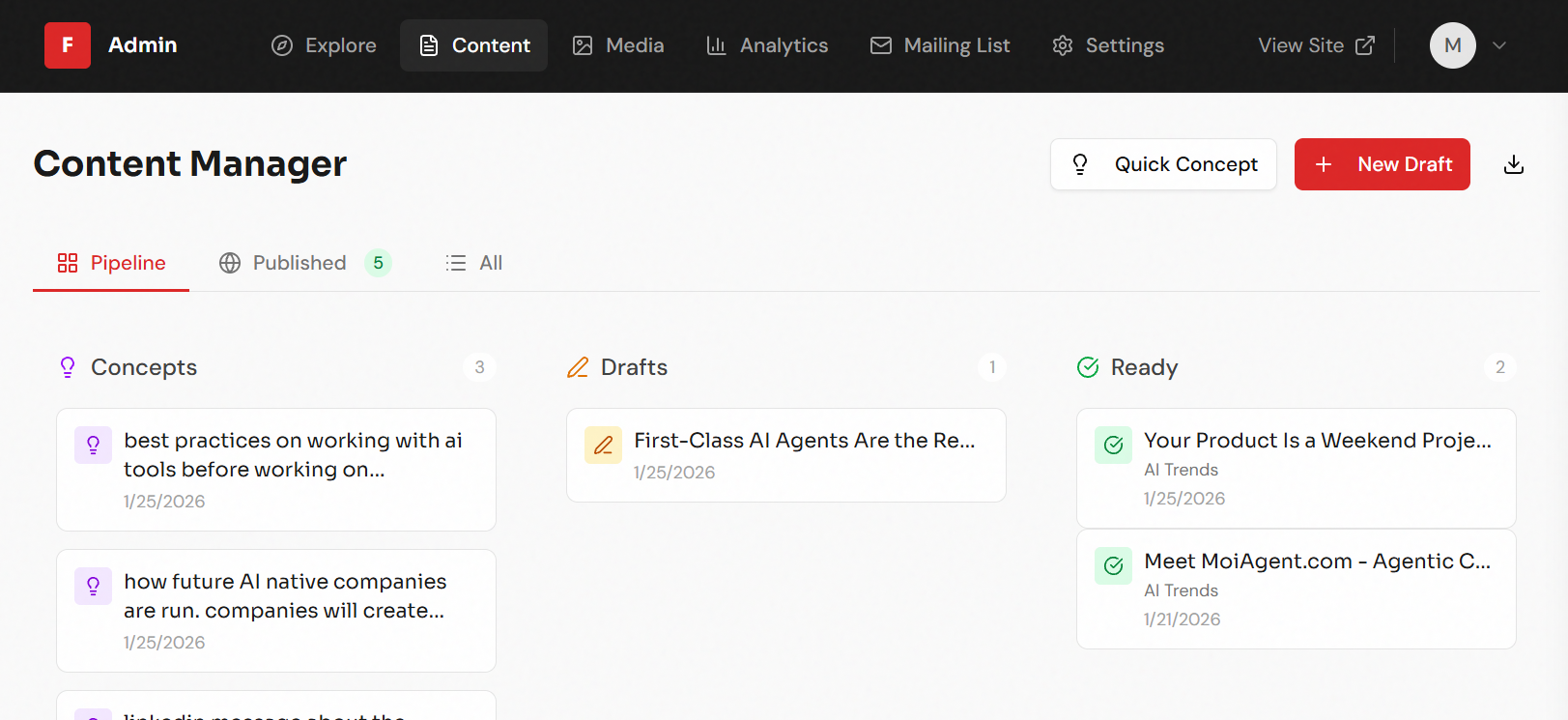
This post was created entirely in custom software I built for myself. Tailor-made for my way of writing content, from notes to outline to images to finished piece.